
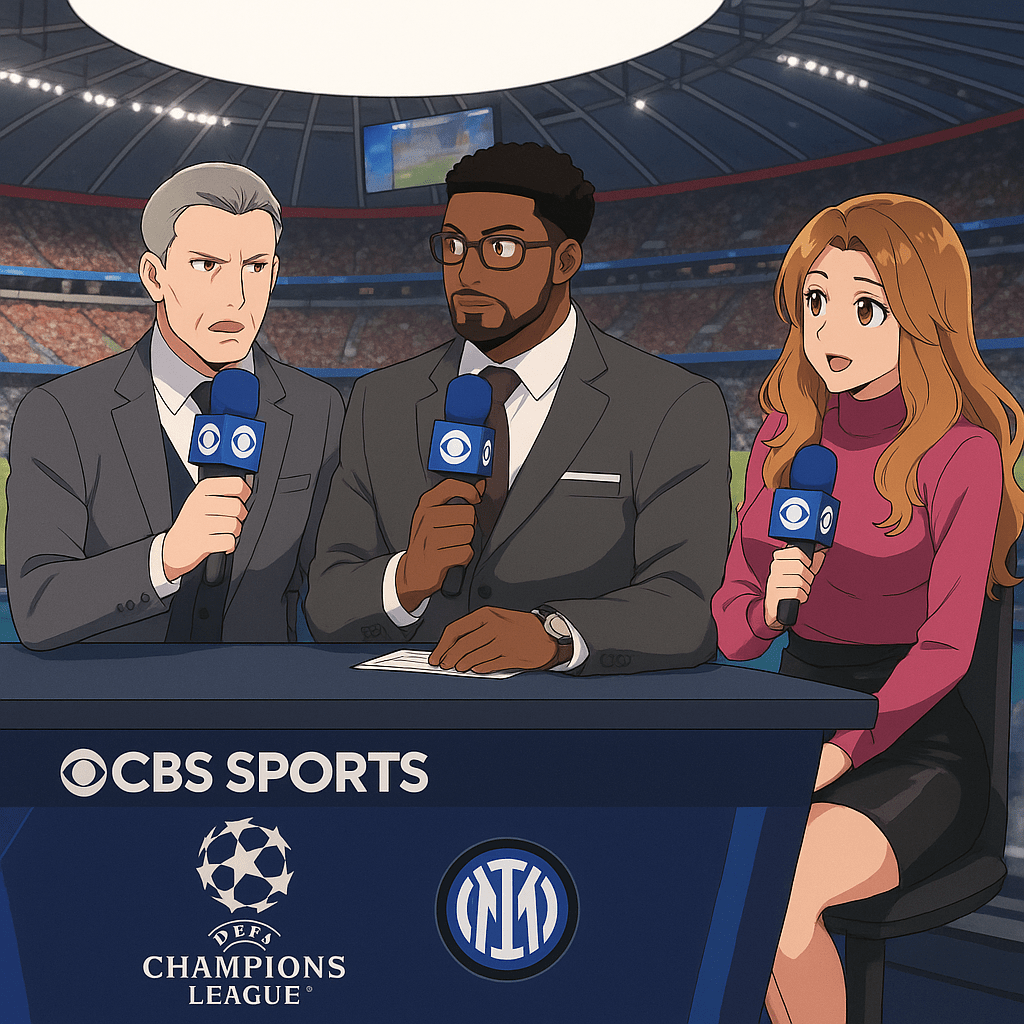
In an increasingly dynamic and competitive sports media landscape, Christine Cupo has established herself as one of the most recognizable and respected voices on CBS Golazo. With her direct style, passion for soccer, and ability to connect with the audience, she’s played a key role in the network’s success and its coverage of the UEFA Champions League. In this interview, Christine takes us behind the scenes of her work, shares her perspective on international soccer, and reflects on what it means to be a leading female voice in sports journalism.
Let’s start from the beginning. What was young Christine like, and how did you first get into soccer?
Young Christine was very outgoing, joyful, athletic, and curious about a lot and loved learning new things. I was the first born in an Italian-American family in New York and between my mother and my father’s interests, I was given the opportunity to try a lot of different sports and activities – I danced ballet, tap, and jazz; I swam competitively; I tried softball and cheerleading briefly, I ran track and field competing in the 55m, 200m, and 400m sprints, but the one that really stuck was soccer. My parents signed me up for a team when I was four years old and I fell in love with it. It’s the one sport that I started life with and grew into continuing to play through adulthood. I remember my first ever game—of course as a 4 year old you don’t really understand the whole concept of soccer or tactics…or positions even. You just want to chase and kick at the ball with your friends, all swarming in the same direction. I remember my father yelling from the sideline “No, no don’t just run anywhere! You’re meant to stay on this side!” And so the next play, I stood in place where he had pointed. He started to tell me “Go! Go!” and in my 4 year old mind, I had no idea what he meant, in my confusion I started to cry. This has become one of the funniest family stories we retell. It’s fortunate that very quickly, I did start to understand the game, positioning, and tactics—from there the rest is history. This was the making of Christine, the lifelong soccer player.
What path did you follow to become a sports journalist?
My path to working in sports is probably one of the most unorthodox! I’m sorry, this is kind of a long story!
I was encouraged by my parents to get good grades in school and pursue a stable career where I could give myself the best opportunities, and so, I did. I had to work to pay my way through University so I was both working full time at an accounting company while also going to school full-time. That job definitely shaped a lot of my decisions and what degree I would pursue.
I graduated with a degree in Economics and by then I had already been working for Deloitte, first in their audit practice and later as a consultant. It was then I went back to University to pursue a Masters degree in English Literature, and took classes specializing in Italian literature—I was considering changing careers and pursuing a PhD in Comparative Literature with a specialization in Italian.
I had always been a good writer and I felt that connection with Italian literature, translation, and language is something I have always been deeply passionate about and thought I would make a good university professor. But then reality set in, the program I wanted to join was highly competitive, would require me to work on my research, dissertation, and also teach Beginner Italian at the university level for very little pay and the path to completing my dissertation could take 8-10 years. It wasn’t something I could afford to do at the time, so I completed my Masters degree and remained working in finance for years.
During all of these years, soccer had remained my one true passion – both playing, following along as a fan, and periodically making guest appearances on podcasts and the like. For over a decade I co-organized one of the largest pick-up soccer groups in NYC. It was never my intention but I would show up faithfully, every week to play and very quickly it became a whole community of us who would show up in numbers to play.
The pickup group grew to roughly 10,000 members over the years and with that, I made a lot of friends from all over the world. It’s because of the soccer pickup group that I was fortunate to meet other people in the soccer media space and little by little, I started being asked on more shows, international media, and radio shows like BBC radio 5 to talk about major tournaments.
I never intended for it to become a job, because I never dreamed that it could become a job; I was just simply doing what I loved and what would make me happy. It wasn’t until right before Covid shut down the whole world that it became a job for me. I had been working more regularly and Luca Momblano had reached out to me to see if I’d be interested in coming on their show. From there I had linked up with Juventibus (Massimo Zampini, Edo Mecca, etc) who had a fully established twitch channel providing fan coverage of Juventus in Italiano. They are a wonderful group of people. From there, they were expanding to English language coverage and myself and Giuseppe Bognanni (a digital creator known by GJustJuve) started working together as co-hosts of that show. From that time, I gained one of best friendships I’ve had in media in Beppe!
If we press the fast forward button, all of this was the catalyst for what would come next. CBS Sports won the broadcast rights to Serie A in the US and had began hiring talent to provide studio coverage. Pete Radovich, the Senior Creative Director and Vice President of Production at CBS Sports (not to mention, the man who has won more Emmy’s for his work than I have lived years on this Earth) reached out to me randomly one day and asked if I could jump on a call with him. In hindsight, it was fortunate that I was so new and naïve in the media space that I had no expectations for what that call could be, nor did I have an understanding for how intimidated I, perhaps, should have been. I spoke with Pete not long after, he explained a lot of what was going on, he asked a lot of questions of me, and asked me to send him over a reel of my work. From there I frantically began gathering up the clips of everything I had done up to that point, then went back and googled “what is a reel?” “How much to include in a reel?” “How long should a reel be?”. I told you, I had no idea of the formalities of media, but I did manage to put together a reel! A few weeks went by and the Head of Talent at CBS Sports asked if I could jump on a quick Zoom to chat and I did. I still didn’t expect much of anything but sure enough a week or two later, I got my first formal contract offer. So began my career in Sports Media.
Your background also includes time as an On-Air Host and content creator for Serie A. Can you tell us more about that experience?
I love Serie A! That was the first league I began watching growing up so having the opportunity to cover the league with CBS Sports/Paramount + was already a dream, getting the opportunity to work directly with Serie A, especially with their newly established office in NYC was just extra special. I always want to see the growth of the league and of course I want more people to love calcio the way that I do. I partnered with Serie A to do a digital dual-language series called “Calcio by the Numbers” a weekly recap show on their digital channels running through the match week highlights based on exemplary statistics for that week. I have a great relationship with them, they are a passionate group of people and I hope to continue to do more work with them in the future.
What’s the current state of soccer in the United States? Media attention and public interest seem to have changed a lot since 31 years ago, when the 1994 World Cup was seen—at least from this side of the Atlantic—as something Americans weren’t really interested in.
Well, I think that depends on how you’re looking at the soccer landscape in the US. The U.S. women’s national soccer team are the most successful team in the world historically and have a legacy of dominance. There has always been very loud, proud support of them in the U.S. and a vibrant fanbase. It’s very easy to grow a fan base when you are very good at what you do! With as good as they have always been, they still had to fight for pay and proper sport standards, but in winning that, they helped to establish an expectation across oceans.
With that having been said, overall the soccer landscape has changed a lot in the U.S. with growing interest and investments more broadly. Domestically, Major League Soccer (MLS) has consistently added new expansion teams to the league in addition to lower division leagues and academies. The wild success that MLS has seen, specifically Inter Miami with the signing of Lionel Messi will be studied in the future. The same can be said of women’s soccer with the expansion of the National Women’s Soccer League (NWSL) and USL Super League. As of July 2025, the U.S. has 8 fully professional soccer leagues (8 men’s, 3 women’s) and another 6+ semi-professional leagues. The growth has reflected a lot of the demand, but I also think that it’s been propelled forward by effective global marketing from large clubs representing the major leagues around the world. There are few places you can walk around in the U.S., especially within the major cities, without seeing fans wearing football/soccer shirts in their everyday lives. Over recent years, English Premier League, Bundesliga, Serie A, FC Barcelona, Bayern Munich, and FIFA have established offices in NYC which has made an impact on U.S. sports markets. While there is still room to grow here for certain, as we get beyond what has been marked as a resounding success in the Club World Cup stateside and move toward FIFA World Cup 2026, we’ll see a lot more activation and new fans emerge in the U.S.
How do you see the evolution of men’s soccer coverage in the U.S.?
Men’s soccer coverage in the U.S. has been pretty comprehensive over the last decade or more, but it had advanced I recent years. As with all sports I think there has been, and will always be conflict, over prime broadcast hours with other sports, both men’s and women’s, in the U.S. With the coverage that traditional networks like CBS, NBC, FOX have been able to offer expanding to cable like TNT, USA, MAX, ION and now with streaming options like Paramount+, Peacock, DAZN, Netflix, Amazon, and YouTube the sky is the limit.
What’s the perception of female sports journalists in the U.S.? I’m thinking of coverage across American football, basketball, and of course, soccer. In Italy, there’s a lot of discussion around the presence of women on the sidelines or on sports shows. Often, physical appearance is prioritized over expertise, and many talented female journalists are sidelined. Does anything similar happen in the U.S., or has the dynamic shifted?
I can’t really speak to the perception of female sports journalists across all American sports coverage because I’m not close enough to it, I think I would do women working in basketball, football, or any other sport a great disservice. From where I sit though, I see female sports journalists in the U.S. as highly respected. They are often athletes or former pros in the sports in which they cover and can offer more diverse analysis and opinions within the space. I think there’s always some consideration of appearance for anyone working in front of cameras, much like in acting, but in my experience, in the U.S. your knowledge, experience, hard work, and your personality holds much more importance. As someone who sort of stands between two worlds, one foot in the U.S. and one foot in Italia, the role of women in media is very different. In Italy, it’s far more likely to find models, actresses, or beauty pageant queens in reporting roles pitchside. I also think it’s even less likely to see women working as analysts/pundits in Italy but I do hope that changes as the women’s game grows in popularity. Football is one of few global sports where the pitch size, ball size, rules, and play do not change in any way from the men’s game to the women’s game and I think eventually, hopefully, the culture and jobs will reflect that.
Thanks to social media, CBS Sports Golazo has become a cult favorite even over here in Europe. With Micah Richards’ jokes, Thierry Henry’s interviews and analysis… how is the show prepared? Do you approach things differently depending on the match or competition being covered?
Ah, yes, you’re referring to the “UCL Today” show hosted by the incomparable Kate Scott, with legendary analysts Micah Richards, Thierry Henry, and Jamie Carragher! Remember earlier when I mentioned Pete Radovich Jr., Sr. Creative Director & VP of Production and all 45 of the Emmy’s he has won? This is him, too! Pete Radovich is a creative mastermind, he has an extraordinary eye for talent (even when it’s raw), what could be, what should be, what will be, and the risk appetite to match all of that to produce something great. I have no part in how the show is prepared but I do have insight into the extremely talented people involved behind the scenes who have worked extremely hard to make UCL coverage the great success that it has become. I would list them all but I would feel terrible accidentally omitting anyone.
What makes Golazo unique in the sports media landscape?
Golazo Network is the very first 24 hour network devoted solely to covering the wide world of soccer for the U.S. Golazo Network programming includes shows: Morning Footy, Attacking Third, Scoreline, and of course matchday coverage for all of the leagues CBS Sports holds the broadcast rights to. Nobody anywhere else is doing this quite like Golazo Network.
Is there a particular episode or segment you’re especially proud of or emotionally attached to?
I’m kind of emotionally attached to all of my work because soccer is just something so deeply personal to me. I’ve had some really high HIGH points: I got to work with Nesta and ask him for the secret to great defending, I’ve interviewed Del Piero, I got to spend two weeks embedded with the entire Juventus squad stateside—all of these would definitely go on my highlight reel.
One of my absolute favorite days of work came early on in my career with CBS Sports. I was sent out to report from the fan club locations for AC Milan and Napoli in the tail end of the 2021/22 season in which AC Milan won the scudetto. It was an important matchday and I was right in the mix of it with AC Milan Club New York City. They are an extremely passionate group, flags waving, horns honking, songs being sung—everything you’d hope to see from a fan club representing a portion of the Serie A fans in NYC being broadcast across the country and seen by the world on social media. It was my last reporting hit of the day, AC Milan had beaten Napoli, the whole group gathered behind me waiting to go live with the studio— and they just erupted in cheers and started singing my name like they would any player. It was both unexpected and wholesome, I started dancing around with them. They won me over that day, and I’ve remained their fan ever since.
How did you get involved with the show? What was your journey like?
When Golazo Network was established, I had already been with CBS Sports due to Serie A coverage. The scope of what I had been covering in world football was already broad from EPL, Serie A, La Liga, MLS, UCL, Europa League, and all of the Women’s leagues which made me a great fit for a show like Morning Footy where we cover the most important matches and news across the globe every weekday morning. I became part of the rotation of analysts on the desk and it’s one of my favorite shows to be a part of due to the variety.
How do you approach your role as an analyst when the topic is Juventus, given your well-known passion for the club?
I think the old school approach in media was to hide your fandom, and I understand that. I, however, think people—fans—are much smarter than that. Let’s be realistic, no one would be working in soccer if they were not a fan first and foremost. I would rather be transparent with everyone that I am, and have been, a Juventus fan since I was kid and yes, as a professional, I am more than capable of being objective in my analysis. If you’re good at it, compartmentalizing “fan Christine” and “analyst Christine” is very easy. I also think my approach when it comes to analyzing players of, “be critical, not cruel” is a departure from some of the media coverage which thrives on creating incendiary headlines for “clicks” or throwing out hot takes. I think these tools make me good at my job.
What’s it like working daily with your colleagues on shows like Morning Footy and Attacking Third?
It’s serendipitous that the majority of my colleagues have also been friends since long before we started working together. In my experience, that’s extremely rare and not something I will ever take for granted. For the Morning Footy show, I have to wake up by 4am and I am not a morning person haha. The added boost of knowing that I’m going into the studio to be among friends to do a job I love doing is priceless. We all want to see each other win and the friend aspect just means we get to pick on each other a little more and joke around! With Attacking Third, it’s the same but with it being a “girls club” we have a special kind of camaraderie that I haven’t felt since being part of a proper soccer team. It just has that kind of dynamic. We’re a diverse group of Division I Collegiate, semi-pro, professional, and retired professional soccer players who just get to cut loose together and hopefully our love of the game is infectious. The more soccer fans, the better!
What do you do to disconnect from the soccer world? Do you have any hobbies or passions outside of work?
If I’m honest, I don’t ever really disconnect. Until my knee surgery (ACL, MCL, Meniscus) I used to play soccer almost every day and I’m still watching all the time. I do spend a lot of time with my Siberian Husky, Gigi (named for Gigi Buffon) playing at the park and generally anything else; she goes everywhere with me! I love art and fashion, dancing at any and every opportunity, museums, and going to Broadway shows. Summer is my favorite time of the year I go to the beach as often as I can. I enjoy doing anything that doesn’t require me to sit still for too long, you can find me biking around NYC. I love horseback riding and jumping, but don’t get to do that as often as I would like. You can usually find me in the gym, I love pilates and yoga.
If you could interview any soccer figure—past or present—who would it be, and why?
Gigi Buffon—He’s an absolute legend and one of my favorite footballers. I was supposed to interview him while he was most recently playing for Parma, but it got cancelled at the last minute. So, fulfilment of what could have been!
Mia Hamm—Legend of the women’s game, one of my personal heroes, National Soccer Hall of Fame, 2x World Cup Champion, 2x Olympic Gold Medalist, 1x Silver Olympic Medalist, 5x U.S. Soccer Female Athlete of the Year. She also notoriously avoids doing any media and I would like to tell her how much of an impact she’s had on me.
What else is needed, in your opinion, to achieve true visibility and parity between men’s and women’s soccer?
This is a very BIG question! There has been great progress with the start of investment in women’s soccer, smart investors know it’s the fastest growing sector and they will see yield on their investments. If you’re a wise investor, you got your investment in early, for example, Michelle Kang. In addition to investment, a universal standard in proper training facilities, youth academies, medical care, and salaries is necessary. Within this same support structure, the women’s game needs to see commitment from brands and long-term brand deals for players and leagues. Media is also vital, the women’s game needs media deals that are dedicated specifically to the comprehensive coverage of the women’s leagues, not the addition of the women’s leagues per the terms of contract for a men’s league, and with the understanding that big matches should be awarded prime time broadcast on major networks. With respect to National team support, policy needs to be established that federations need to offer equal funding to their men’s and women’s teams with timely allocation of those funds and salaries. I also think we need to see more expanded women’s competitions to push the women’s game into alignment with those of the men’s game. If there’s anything that we have learned in recent years, it’s that small investment has yielded big changes in competition in women’s soccer. The game is getting better. We are seeing record transfer deals like never before.
Women’s teams that are attached to the success and failure of their Club’s men’s team, which we commonly see outside of the U.S., have the unique problem of suffering diminished funding, inadequate training and matchday pitches, subpar medical and training staff, and in the worst cases—being demoted to a lower division despite on pitch success, due to the lack of funding because the Club have prioritized the men’s team. Mandates should be put in place to ensure that both men’s and women’s teams falling under the same Club are treated as both independent and equal.
The last thing that will need to change is cultural—respect for the game and respect for women ballers. Cultural changes will come slower than the investments, but the increased investment brings me great hope.
And finally, what are your plans or dreams for the future?
I’m not much for planning too far ahead! Life can change so much day to day, I find that when I decide I want to do something, I just do it! My current plan is to work as much as I can, do more reporting and interviews, travel more, spend time with my family and friends, and enjoy the ride!
This “dreams for the future” question is going to make me self-conscious because what if I’m not dreaming big enough?? Okay, big dreams… I would love to spend an entire Summer in Italy, I want to make a documentary series about calcio femminile, I want to buy property just outside of NYC where I can have soccer fields and an animal rescue, and I want to see a football match (at least one) in every country.

Sostieni La Gabbia
2,00 €
 lagabbiadiorrico.com
Lascia un commento