
Presentiamo di seguito una intervista con Rhulani Mokwena, allenatore dei Mamelodi Sundowns, squadra sudafricana che rappresenta in questo momento una delle realtà più interessanti del panorama internazionale. Ringrazio il coach per l’estrema gentilezza nel concedermi l’intervista che, in questa sede, rimarrà in inglese al fine di favorirne una maggiore diffusione.
Do you think football should take itself less seriously?
Football means different things to different people. It’s the most important of the least important things in life but Football is a beautiful game, and it’s important to remember that it’s meant to bring joy and entertainment to both players and fans. While the competitive nature of the sport is undeniable, it’s also crucial to maintain a sense of enjoyment and passion.
What were your duties as an assistant manager at Orlando Pirates, and how did that experience help you become a manager?
As an assistant manager at Orlando Pirates, my duties included supporting the head coach in various aspects of team management, such as training sessions, tactical analysis, and player development. This experience provided me with valuable insights into the intricacies of managing a big professional football club and helped shape my understanding of the game. When I had the opportunity to serve as interim manager after Sredojević’s resignation, it further accelerated my growth, allowing me to gain hands-on experience and develop my managerial skills. I become not only a better coach but a better person.
What advice would you give to aspiring coaches who haven’t had a playing career?
For those without a playing career, my advice would be to focus on gaining a deep understanding of the game through continuous learning and studying. Immerse yourself in football literature, watch matches attentively, and analyze different coaching methodologies. Seek opportunities to work with youth teams or assist experienced coaches to gain practical experience. Dedication, knowledge, and a strong work ethic can help compensate for the lack of a playing career and pave the way for a successful coaching journey.
Who are your reference models when it comes to coaching?
I draw inspiration from several successful coaches, and two notable figures who have greatly influenced my coaching philosophy are Pep Guardiola and Roberto Di Zebri.
Certainly! De Zebri’s football and Pep Guardiola’s philosophy share certain similarities but also have notable differences. Both De Zebri and Guardiola emphasize possession-based football, focusing on controlling the game through ball retention and fluid passing. They believe in building attacks from the back, with the goalkeeper and defenders actively involved in initiating the team’s offensive play. Both coaches prioritize a proactive approach, seeking to dominate matches through constant pressure and high intensity.
They encourage their teams to press aggressively, win the ball back quickly, and maintain a high defensive line to limit the opponent’s options. In terms of differences, De Zebri’s football tends to be more direct and vertical, with an emphasis on quick transitions and vertical passing. His teams often look to exploit spaces behind the opposition’s defensive lines through fast counter-attacks and direct attacking play. On the other hand, Guardiola’s philosophy places a greater emphasis on intricate positional play and patient build-up.
His teams are known for their meticulous passing patterns, positional rotations, and the ability to patiently probe the opposition’s defense until gaps appear. While both approaches value possession, Guardiola’s teams typically prioritize ball circulation and maintaining control over the game, sometimes referred to as “tiki-taka.”
In contrast, De Zebri’s football is characterized by a more direct and dynamic style that aims to create goalscoring opportunities quickly. Overall, while De Zebri and Guardiola share common principles such as possession-based football and pressing, their approaches to the game exhibit some nuanced differences in terms of directness, verticality, and patience in build-up play. I’m also a big fan of Fernando Diniz, who is known for his innovative approach to the game, which he refers to as “Relationism.” Relationism is a model that emphasizes the interconnectedness and interdependence of players on the field, focusing on fluidity, collective understanding, and dynamic movement. At the heart of Relationism is the belief that football is a collective sport where players should constantly seek to establish and maintain relationships with their teammates.
It promotes the idea that players should not be limited to fixed positions or roles but should have the freedom to interchange positions, create passing options, and support each other in different areas of the pitch. Diniz’s teams typically adopt a possession-based playing style, wherein they prioritize ball circulation, quick passing, and positional rotations.
The aim is to create numerical superiority in different areas of the pitch, exploit spaces, and overwhelm the opponent’s defense.
Key principles of Relationism include: 1. Fluidity and Movement: Players are encouraged to constantly move and interchange positions, creating passing options and confusing the opposition’s defensive structure. This fluidity allows for quicker and more dynamic attacking transitions.
2. Collective Understanding: Relationism emphasizes the development of a collective understanding among players. It involves training players to have a strong awareness of their teammates’ positioning, movement patterns, and decision-making tendencies. This collective understanding enhances teamwork and enables players to make split-second decisions based on their understanding of each other’s intentions.
3. Proactive Pressing: Relationism places great importance on pressing as a team. Players are expected to press collectively and selectively to regain possession as quickly as possible. This aggressive pressing style aims to disrupt the opponent’s build-up play and create turnovers in advantageous positions.
4. Technical Proficiency: Diniz’s model encourages players to have a high level of technical proficiency, particularly in terms of passing accuracy, first touch, and ball control. This allows for quick and precise passing combinations, maintaining possession, and executing intricate positional play.
5. Offensive Mindset: Relationism promotes an offensive mindset, encouraging players to be proactive in their decision-making and consistently seek attacking opportunities. This involves taking risks, attempting creative solutions, and maintaining a positive approach throughout the game.
While Relationism has garnered attention for its innovative approach, it should be noted that its implementation requires a high level of player understanding, technical ability, and tactical discipline. It may take time for players to fully grasp and adapt to this playing style. Overall, Relationism, as a model by Fernando Diniz, aims to create a dynamic and cohesive playing style that emphasizes collective understanding, fluid movement, and proactive attacking play. It challenges traditional positional roles and encourages players to constantly interact and support each other on the field.
How does your Christian faith play a role in dealing with players and the ups and downs of your profession?
My Christian faith is a fundamental aspect of my life, and it guides my interactions with players and influences how I navigate the challenges of my profession. It helps me approach situations with empathy, compassion, and forgiveness. It reminds me to treat each individual with respect, regardless of their circumstances, and encourages me to lead by example, both on and off the pitch. Ultimately, my faith serves as a foundation for building positive relationships and fostering a supportive environment within the team.
How do you deal with young players who are part of the TikTok generation and may struggle to stay focused for a long time? How do you keep them involved in the project? Do you adjust your team speeches?
The younger generation’s exposure to social media and technology has undoubtedly influenced their attention spans and preferences. To keep young players engaged, it’s important to adapt our coaching methods. I believe in creating a dynamic and interactive training environment that incorporates elements they find relatable and enjoyable. For example, incorporating short, focused training drills or small-sided games can help maintain their interest and keep them actively involved. Additionally, utilizing video analysis tools and interactive training apps can provide a more interactive and engaging learning experience. As for team speeches, it’s essential to communicate in a concise and impactful manner, emphasizing key messages and using visual aids or multimedia to enhance understanding.
How would you describe your playing model? Is it more positional or functional play?
My preferred playing model combines elements of both positional and functional play and maybe now with some influences from Relationism. I aim to create teams that are tactically versatile, adaptable to different game situations, and capable of controlling the game through possession. Positional play helps establish a structured framework and enables players to understand their roles and responsibilities while developing relations with different players within specific areas of the pitch. Functional play, on the other hand, emphasizes understanding the functions and responsibilities of different positions, allowing players to interchange positions and exploit spaces effectively.
What can you tell us about the goalkeeper’s role in your system, particularly regarding the utilization of the goalkeeper in the build-up?
In my system, the goalkeeper plays a crucial role in the build-up phase. We prioritize using the goalkeeper as an additional option to initiate attacks from the back. By involving the goalkeeper in the build-up, we create numerical superiority and force opponents to adjust their pressing actions. Our goalkeeper, Ronwen Williams, often receives the ball centrally in the first phase of play to prevent opponents from easily forcing the play towards one side. This helps us maintain control and build attacks patiently, allowing us to dictate the tempo of the game. The goalkeeper’s ability to distribute the ball accurately and make quick decisions is vital in executing this strategy effectively.
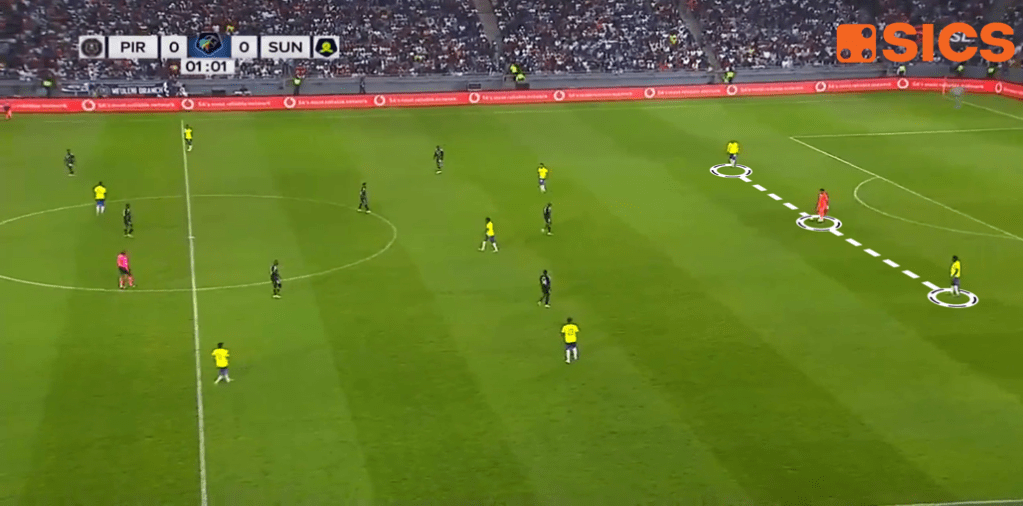
How do you build the patient and ball-controlling approach that characterizes Mamelodi Sundowns?
Building a patient and ball-controlling approach requires a combination of tactical understanding, technical proficiency, and a shared team mentality. It starts with instilling a strong belief in the importance of maintaining possession and controlling the game. In training, we focus on developing players’ technical skills, decision-making abilities, and spatial awareness. We emphasize the importance of quick and accurate passing, intelligent movement off the ball, and maintaining positional discipline. Through repetition and tactical drills, we aim to create a collective understanding of how to control the tempo of the game and create scoring opportunities while minimizing risks.
How do you train your players to read and occupy spaces effectively?
Reading and occupying spaces effectively is a crucial aspect of our training. We work on improving players’ awareness of space through various exercises and drills. This includes analyzing game situations, studying opponents’ defensive structures, and identifying gaps and areas of vulnerability. We also emphasize the importance of intelligent movement off the ball to create space for teammates and exploit spaces in the opposition’s defense. Tactical sessions and video analysis play a significant role in enhancing players’ understanding of space, allowing them to make better decisions and contribute to our overall attacking strategy.
In possession, you’ve taught your team to overload the middle of the park to create numerical superiority. How pivotal is it for you to have a free man in the middle channels (center and half-spaces)?
Having a free man in the middle channels, such as the center and half-spaces, is crucial to our playing style. It allows us to create numerical superiority in key areas of the pitch, providing passing options and facilitating ball progression. By overloading the middle of the park, we can draw opponents towards us, creating space in wider areas for our full-backs or wingers to exploit. It also enables us to quickly transition from defense to attack and maintain control of the game by constantly having passing angles and options available.
The ongoing debate revolves around positional play versus functional play. What are your thoughts on this argument? Do you believe positional play has reached a plateau?
The debate between positional play and functional play is an interesting one. Both approaches have their merits, and I believe they can coexist depending on the team’s characteristics and the specific game situations. Positional play, with its emphasis on maintaining structured positioning and fluid movement, can be effective in controlling possession and creating numerical advantages. Functional play, on the other hand, focuses on players’ specific functions and responsibilities within the team, allowing for tactical flexibility and adaptability. While positional play has seen significant development, I don’t believe it has reached a plateau. Football is constantly evolving, and coaches continue to innovate and find new ways to enhance positional play concepts. There is always room for refinement and adaptation to suit the everchanging dynamics of the game.
The recent World Cup showcased the quality of African coaches, such as Walid Regragui and Aliou Cissé. Do you think African managers are underrated?
Are there any other African gaffers you highly rate? The recent World Cup indeed highlighted the quality of African coaches, and I do believe that African managers are sometimes underrated in the global football landscape. There is a wealth of talented coaches in Africa who bring unique perspectives, diverse experiences, and a deep understanding of the game. Aside from Walid Regragui and Aliou Cissé, whom you mentioned, I highly rate coaches like Pitso Mosimane, who has achieved great success with Mamelodi Sundowns, and Hervé Renard, who has won multiple African Cup of Nations titles with different national teams. These coaches have demonstrated their tactical acumen, man-management skills, and ability to excel in challenging environments.
How long will it take to see an African manager coaching a big club in one of the European Top 5 championships?
The opportunity for an African manager to coach a big club in one of the European Top 5 championships depends on various factors, including individual circumstances, opportunities, and the perceptions within the football industry. While there are challenges and barriers to overcome, I believe it is only a matter of time before we see an African manager at the helm of a top European club. With the growing recognition of African talent and the increasing globalization of football, the doors are slowly opening, and I am optimistic that the right opportunity will arise for an African manager to showcase their abilities on the biggest stage.
Sostieni La Gabbia
La Gabbia è un progetto senza editori alle spalle. Nonostante ciò continua la sua opera divulgativa offrendo contenuti gratuiti per tutti. Se vuoi sostenerne l’impegno e aiutare a sopportare i costi di mantenimento del sito, puoi farlo tramite PayPal.
2,00 €
 lagabbiadiorrico.com
Lascia un commento